High Frequency Oscillation – Shaken by Bad News!

oscillatorSummary: Two Papers Published Online in the NEJM, OSCILLATE and OSCAR, have failed to demonstrate that HFOV benefits patients with ARDS. In the OSCILLATE study there was an 11% increase in 28 day mortality (NNH 9). HFOV should not be used in routine management of patients with ARDS.

For the past two decades many intensivists have used an “open lung” approach to managing hypoxaemia in ARDS. This approach involves using high levels of PEEP, inverse ratio ventilation (IRV), airway pressure release ventilation (APRV) or high frequency oscillation ventilation (HFOV) – to keep severely injured lungs in a state of inflation during most of the respiratory cycle. “Open Lung” can be achieved by using high PEEP and small tidal volumes, or moderate levels of PEEP and long inspiratory times. In either case mean airway pressure increases. The most sophisticated method of using PEEP involves the construction of pressure volume curves and setting the PEEP above the lower inflection point. To date, the high PEEP approach has neither been proven to be better or worse than the incremental PEEP approach based on fiO2. However a 2010 meta-analysis has suggested that high PEEP may be beneficial in ARDS. With long inspiratory times oxygenation occurs principally during inspiration rather than expiration; functionally ventilation occurs on the expiratory limb of the volume-pressure curve.
There is good physiologic reasoning behind the open lung approach. Severe ARDs is characterized by massive atelectasis, increased lung water and pleural effusions; functional residual capacity is obliterated. As most gas exchange occurs in expiration, and end expiratory lung volumes are lost, open lung approaches use the inspiratory reserve volume. Further, it is widely believed that phasic opening and closing of injured lung units and uninjured adjacent units results in ventilator induced lung injury (atelectrauma). Open lung approaches prevent atelectrauma. The majority of ICUs utilize conventional ventilator strategies such as pressure support, pressure control (or bilevel) or volume assist-control in early ARDs. However, in patients with severe and refractory hypoxic respiratory failure, units differ between using high PEEP and so called “advanced” modes to maintain oxygenation. Despite the conceptual attractiveness of IRV, APRV and HFOV there has always been an evidence gap in support of these modes: nobody knows how much the lung stretches. There is no easy way to measure end inspiratory lung volumes and hence to evaluate the risk of volutrauma. Proponents of “advanced” modes will argue that absence of evidence does not mean absence of efficacy: clearly open lung modes of ventilation improve oxygenation – so this must be good. However, we have decades of data suggesting that prone positioning improves oxygenation, but not outcomes.

After a long wait, we have now seen the publication of two studies on HFOV – the multi-national OSCILLATE study, and UK based OSCAR trial. The results are not good.

OSCILLATE

Background and Methods: This was a multi center trial of 38 hospitals in Canada, the United States, Saudi Arabia, Chile, and India from July 2009 thru August 2012. Patients were eligible for inclusion if they had had an onset of pulmonary symptoms within the previous 2 weeks (i.e. this was an acute illness), had been intubated, had hypoxemia defined as a PaO2/FiO2 (PF) ratio of ≤200, with an FiO2 of ≥0.5), and had bilateral infiltrates on CXR. These criteria must have been met within the previous 72 hours. The authors were careful – patients who met criteria were put on pressure control ventilation, TV 600ml, FiO2 0.6 and PEEP 10cmH2O. If, after 30 minutes, the PF ratio was still below 200, the patients were enrolled in the trial. Patients were randomized to HFOV or conventional ventilation (CV). The patients were remarkably well balanced at baseline – and very sick – with mean Apache II scores in both groups of 29.

Technique: a recruitment maneuver was performed initially (40cmH2O for 40 seconds) then HFOV was commenced at a mean airway pressure of 30 cmH2O, adjusted to keep the PaO2 between 55 to 80 mm Hg (7.3 to 10.5 kPa). The frequency was adjusted to keep the pH above 7.2. Once mean airway pressure (mPaw) dipped below 24 cmH2O conversion to CV was considered; if mPaw went below 20cmH2O – conversion was mandatory. The CV group received a recruitment maneuver, then pressure controlled ventilation with TV 6ml/Kg and PEEP adjusted according to protocol. Initial PEEP was 20cmH2O. Patients could also receive volume assist control or pressure support ventilation. For patients with good compliance and gas exchange (presumably during the weaning phase), the investigators did not set limits for tidal volumes. A weaning protocol governed both limbs.

Results: the primary outcome was in-hospital mortality. The study was stopped early because of increased risk in the study group. At the time of termination, 571 patients had been enrolled, of whom 548 had undergone randomization: 275 to the HFOV group and 273 to the control-ventilation group. A total of 129 patients (47%) in the HFOV group, as compared with 96 patients (35%) in the control group, died in the hospital (relative risk of death with HFOV, 1.33; 95% confidence interval, 1.09 to 1.64; P=0.005) – an absolute risk INCREASE of 12%! This was independent of any other risk factor other than HFOV and was consistent at 28 days. Indeed 28 day mortality was 40% in HFOV group (which is not particularly bad) versus 29% (which is really excellent) in the conventional ventilation group – absolute risk increase 11% – number needed to injure 9. The duration of hospital stay for survivors was, on average, 5 days fewer in the CV group (although statistical significance is not reported) 25 versus 30 days.

Did HFOV have a physiological effect? Yes – patients almost immediately needed more vasopressors, more sedation and more neuromuscular blockade. There were fewer cases of refractory hypoxaemia but this had no statistically significant impact on outcomes.

My Impression

So, what to make of this study? Firstly, let us be clear – this was an excellent study (that we were all awareards of) performed by experts in the field of mechanical ventilation, who have a long track record of publication and interest in HFOV. They were not expecting the published results. This is a significant setback to our understanding of ARDS and interventions to rescue patients from severe hypoxaemia. Among my critical care colleagues, there are those of us who are proponents of ARPV and those of us who use HFOV. The published results ask as many questions about APRV as they do about oscillation. Can the worse outcomes be explained by increased doses of vasopressors and more sedation? No, I don’t believe it to be so: it is inconceivable that increased drug utilization could explain an 11% risk increase at 28 days. It is more likely that HFOV exacerbates ventilator induced lung injury (VILI).
OSCAR Study

The OSCAR study took place in the UK and included nearly 800 patients that had PF ratio <200 and wereOscar randomized to HFOV or CV. There was no significant between-group difference in the primary outcome, death at 28 days, which occurred in 166 of 398 patients (41.7%) in the HFOV group and 163 of 397 patients (41.1%) in the conventional-ventilation group (P=0.85). In other words – HFOV did not benefit these patients. Patients enrolled in this study had an average Apache II of 21 – lower than Oscillate – but had equally bad gas exchange when recruited. Although there was an increase in the use of muscle relaxants, there was no evidence of increased vasopressor requirements.

Of interest, patients in OSCAR had similar (although worse) 28 day mortality rates to those in the HFOV arm of the OSCILLATE study. It is worth looking at the LOV and EXPRESS trials for comparison. The EXPRESS trial had slightly older patients (60y both groups) with better gas exchange – PF ratio 143 and 144. Twenty eight day mortality was 31.2% and 27.8% (lower in high PEEP approach but not significant). The LOV study had patients in the same age range as both of these studies, but the PF ratios were significantly higher (144 in both groups); Apache II scores were 24 and 25 (patients were sicker than OSCAR). Mortality rates for all cause in hospital were 36.4% and 40.4% (again not significant). The lower end outcome is similar to the conventional group (and indeed had similar vent strategy to that group) in OSCILLATE. This suggests that the better outcomes in the conventional group in OSCILLATE accurately reflect true outcomes, and that the 28 day mortality in the LOV trial over-estimates outcomes at hospital discharge. But, can the difference in gas exchange really explain why the outcomes in OSCAR, in the conventional group at least, were 10% worse than EXPRESS? I don’t know – but comparing OSCILLATE to OSCAR – a 29% 28 day mortality (similar to LOV) is substantially lower than the 41% in the UK trial. These data suggest that the conventional group in that study did worse than expected. And, if this were the case, then HFOV was harmful in the OSCAR study too: the mortality rate for HFOV was essentially the same in both studies. Ok that might be conjecture – but take my point: a 41% mortality rate for ARDS is very high in the setting of a randomized controlled trial. For example, in the original ARMA trial the mortality rate in the control group (high TV) was 39.8% versus 31%; PF ratios 138 and 134. In the ALVEOLI trial the mortality rates were 24.9% (high PEEP) and 27.5%; PF ratios were 165 and 154. I have long argued that many of the patients in the NIH studies probably didn’t have ARDS – but the outcomes in OSCAR are the worst published in a multi center trial since the control group in Aries. Whatever way you look at it – this is all BAD NEWS for HFOV.

HFOV – is it safe?

One striking thing about these studies is how much the conflict with a previous meta-analysis of previously published papers. In that paper eight randomized controlled trials (n=419 patients) were included; the majority of patients had ARDS. Patients on HFOV had better oxygenation and reduced mortality (risk ratio 0.77, 95% confidence interval 0.61 to 0.98, P=0.03; six trials, 365 patients, 160 deaths). These results conflict directly with the outcomes of OSCILLATE and OSCAR: it is scary how meta-analysis of small studies (publication bias) can be misleading.

So, is it time to wrap up your oscillator and consign it to the ventilator graveyard? For ARDS – for routine practice – I think so.

1-forward-2-backFor rescue therapy or as a bridge to ECMO – HFOV may still have a role. Oscillation remains a useful therapy for broncho-pleural fistula and perhaps for severe lung contusion. But in other settings – I believe – use with extreme care. Is it time for a complete re-evaluation of open lung approaches in ARDS? Perhaps so – certainly before we put patients on extreme IRV modes (such as APRV) or HFO we should ask – “have I maxed out my options with conventional ventilation?”
One Step Forward – Two Steps Back.
Beachchair and Blood Pressure

BeachChairMAPIt is now more than 5 years since the Anesthesia Patient Safety Foundation highlighted the risk of central nervous system injury following anesthesia for shoulder surgery (SS) in the Beachchair position (BCP) (click here). Although we can never be certain, it appears likely that such injuries – principally devastating stroke, results from hypoperfusion and watershed ischaemia. Most anesthetists agree that, in the seated position, the mean arterial pressure as measured by a brachial cuff, under-estimates the pressure at the circle of Willis by 15mmHg or more. The safe lower range of MAP with regard to cerebral auto regulation remains unclear, but it is certainly not below 50mmHg (click here). Regardless, if we are to believe in the “Waterfall” effect of blood pressure, then a MAP of 65mHg from an arm BP cuff is marginal. If an arterial line is place – a procedure rarely performed in orthopedic shoulder patients – the transducer should be sited at the external auditory meatus. Although there are proponents for cerebral oximetry as a monitor in this setting – I do not believe that data are sufficient to demonstrate sensitivity and specificity of this device (here). The majority of experts in the field agree that the best option is to keep BP as close to baseline as possible if general anesthesia is administered for SS in BCP (here here and here). Clearly – “induced hypotension” is a bad idea in this setting. Also, the placement of the BP cuff on the leg or ankle (so that it does not cut of the iv line periodically) would appear most unwise. In one paper from Korea (click here), ankle blood pressure was substantially higher (up to 30mmHg for systolic pressure, 20mmHg mean pressure) compared with brachial pressure in the Beachchair position. In other words – if you are using an ankle cuff, the measured blood pressure (MAP) may be 35mmHg or more higher than the pressure seen at the circle of Willis.

My own practice is to use a brachial cuff and administer a phenylephrine infusion to keep the MAP above 75mmHg (or at the normal awake range for the patient). This appears to be the best approach based on my reading of the literature and available technologies. I would urge orthopedic anesthetists in the West to read the articles referenced here and come up with their own protocols. Comments?

Transfusion Strategy – Think Restrictive

nejm_transf_1.2013A half generation ago, the TRICC trial (here) suggested that routine blood transfusion in critically ill patients did not confer benefit if the haemoglobin level was above 7g/dl. This resulted in a evidence based paradigm for lower transfusion triggers. The problem was – how do you deal with the bleeding patients?
A recent study in NEJM (here) looked at liberal versus restrictive transfusion practices on patients admitted with gastrointestinal bleeding.

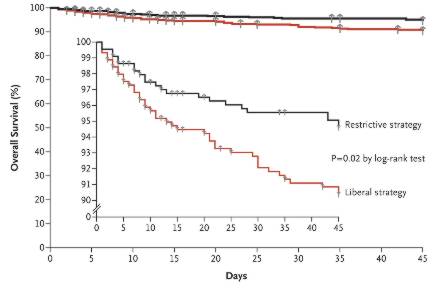
921 patients with severe acute upper gastrointestinal bleeding were included in the study: and 461 of them were randomly assigned to a restrictive strategy (transfusion when the hemoglobin level fell below 7 g per deciliter) and 460 to a liberal strategy (transfusion when the hemoglobin fell below 9 g per deciliter). Randomisation was stratified according to the presence or absence of hepatic cirrhosis.

Substantially more patients in the liberal strategy group received transfusion: 395 (85%)  versus 236  (49%) liberal versus restrictive (P<0.001). The conventional wisdom would hold that greater oxygen carrying capacity in the liberal group would result in better outcomes. The null hypothesis would be that there was no difference. However, the patients in the restrictive group had BETTER OUTCOMES. The hazard ratio for 6 week mortality was 0.55; 95% confidence interval [CI], 0.33 to 0.92; P=0.02) [with HR a number of <1 reflects benefit, >1 reflects injury]. The absolute risk reduction was 4% (5% restrictive, 9% liberal p = 0.02; NNT 25). In addition, patients in the liberal strategy group had a 6% absolute increase (number needed to injure 16; (P=0.01) ) in the risk of further bleeding.
There was an absolute risk reduction of adverse events of 8% in the restrictive group (NNT 12; p = 0.02). Restrictive transfusion also resulted in better survival in patients with peptic (gastric or duodenal) ulcers, and those with mild to moderate cirrhosis.

Why would bleeding patients do better if transfusions are witheld? There are many potential reasons: 1. The concept of damage control resuscitation: teleologically we have evolved to handle hypovolaemia and can survive considerable blood loss. Blood transfusion without source control may cause clots to destabilise and further bleeding to occur. 2. Blood is immunosuppressive: patients who are transfused are at elevated risk of infectious complications. 3. In this particular study patients in the liberal transfusion group had higher portal pressures and were more likely to rebleed (but so too were patients with peptic ulcers). 4. Transfusion may result in volume overload, abdominal compartment syndrome, myocardial ischaemia and transfusion related lung injury.

What are the implications of this study. Approach with caution! This study does not license clinicians to withhold blood from ex-sanguinating patients. Nor does it prove anything about transfusion in the setting of non gastrointestinal blood loss. However, it does provide us with further information about the safety and implications of blood transfusion in a specific setting. Allied with accumulating data detailing the hazards of colloid transfusion, adverse outcomes associated with crystalloid over-resuscitation, and the ongoing controversy regarding albumin – one has to wonder where we are with fluid resuscitation. Remembering that red cell transfusion is a key component of the Rivers’ surviving sepsis protocol, one wonders if this is the first real nail in the coffin for that approach.

Comments are welcome here.

Troponin Leak Postop – what does it mean?

vision studyTwenty years ago perioperative myocardial ischaemia was a relatively easy thing to diagnose – we checked ECG looking for ST segment and T wave changes, and looked for an MB-CK rise. Then troponin arrived, and suddenly the proportion of patients with perioperative ischaemia increased drastically. For many of us, the report of a “postoperative troponin leak” results in a shoulder shrug: we don’t know what it means, we don’t really know the long term implications.

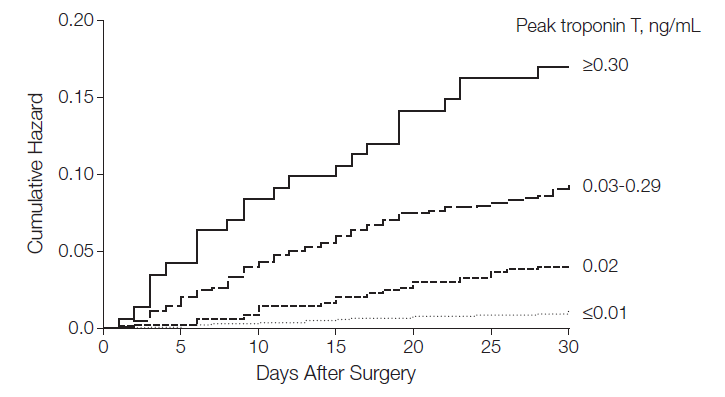
Thankfully, a landmark study, VISION (click here), has provided us with quality epidemiologic data. This was a cohort study of 15000 patients >45 years that underwent non cardiac surgery and had troponin T (TnT) measured in the first 3 postoperative days. All patients had to have procedures that required overnight stay in hospital. The main outcome measure was 30 day mortality.

After 30 days 1.9% of patients had died. Patients were more likely to die if their peak TnT level was 0.02 ng/ml (versus reference range of <0.01 ng/ml). This occurred in 11.6% of patients. The greater the TnT level, the more likely the patient was to die. They were able to stratify risk depending on TnT levels. Patients with a peak TnT value of 0.01 ng/mL or less, 0.02, 0.03-0.29, and 0.30 or greater had 30-day mortality rates of 1.0%, 4.0%, 9.3%, and 16.9%, respectively (figure above).

Risk was expressed in terms of Hazard Ratio (HR): greater HR = more likely adverse outcome with 1 being equivalent to no additional risk, <1 lower risk, >1 higher risk. Peak TnT of 0.02 ng/mL (adjusted hazard ratio [aHR], 2.41; 95% CI, 1.33-3.77); 0.03 to 0.29 ng/mL (aHR, 5.00; 95% CI, 3.72-6.76); and 0.30 ng/mL or greater (aHR, 10.48; 95% CI, 6.25-16.62).

Who was at increased risk? The older the patient the higher the risk. Emergency surgery, general surgery, neurosurgery were associated with increased risk. Vascular surgery was not, although the presence of peripheral vascular disease, COPD, previous stroke, coronary arterial disease and cancer did predict adverse outcome. Diabetes, obesity, afib, OSA, hypertension, orthopaedic/thoracic urology surgery – did not predict adverse events.

Conclusions: these data demonstrate the efficacy of TnT measurement in determining perioperative prognosis. 1in 25 patients with a peak TnT measurement of 0.02ng/mL,1 in11patients with a peak TnT measurement of 0.03 to 0.29ng/mL, and 1 in 6 patients with a peak TnT measurement of at least 0.30ng/mL will die within 30 days of surgery. Two questions arise from this study: 1. should we be routinely measuring TnT postoperatively in surgical inpatients >45 years; 2. If the patient has a troponin leak – what should be do then: PCI, aspirin, clopidogrel, statins, betablockers, all of the above, none of them? Will routine measurement of TnT result in a dramatic increase in cardiology consultations with little evidence that there are interventions that may improve outcomes in this setting?

The Obesity Paradox – Weight there’s more!

chandler-weightThe media are constantly harping on about the obesity epidemic – “two in three of us are fat – this is going to lead to an explosion of obesity related morbidity – heart disease, cancer, cerebrovascular disease, crumbling joints etc.” It never seems to occur to the same talking heads on television and in print media that life expectancy continues to improve worldwide, without any great new medical advances over the past 2 decades (during which the obesity epidemic emerged). In perioperative medicine and critical care we have data that an “obesity paradox” exists – that individuals with a BMI between 25 and 35 (overweight and grade 1 obesity) have lower mortality rates in perioperative medicine (references 1. Here, 2. Here) and critical illness (references 1. Here; 2 Here; 3 Here; 4. Here). The reasoning why overweight and mild obesity (being chubby) may confer benefit is an increase in physiology reserve, delivered in part by an increase in lean body mass. As patients become heavier (body mass index; BMI>35, grade 2 and 3 obesity), they start manifesting mass related injury and metabolic disease. Metabolic syndrome unquestionably increases long term risk (here).
But what of the general population? Life insurance companies continue to penalize chubby folks based on actuarial figures from the 1960s – it that fair? It turns out that it is not. Hold your breath – a 2.88 million patient meta analysis performed by a group of US researchers and published in last week’s JAMA (here), has completely moved the goalposts for desirable BMI. In terms of Hazard Ratio (where HR of 1 = BMI 20-25), BMI of 25-30 had a HR for all cause mortality of 0.94 (lower; CI 0.91-0.96). BMI  30-35 had HR 0.95 (lower; but CI 0.88 – 1.01 NS). BMI 35-40 HR 1.29 (higher CI 1.18-1.41). In other words – overweight patients had LOWER all cause community mortality than BMI 20-25. Being obese up to BMI 25 did NOT increase mortality risk, and only individuals with BMI >35 had increased risk.

People – you need to face up to it: OVERWEIGHT IS THE NEW “NORMAL.” Perhaps “Chubby Chandler (above)” was the healthy one.

More comments to follow.

Is it time to re-evaluate core concepts of Neuro-Intensive Care?

Over the past 2 or 3 decades a variety of technologies have been introduced into the clinical care of the brain injured patient – intraventricular ICP monitoring devices,SjVO2, brain tissue oxygen devices, microdialysis, xenon flow scanning, etc. However, compared with general critical care, the evidence base for protocols based on the utilization of these technologies is poor. There are 3 clinical approaches to managing the patient with traumatic brain injury – an ICP based strategy (the intracranial pressure is targeted at below 20mmhg), a CPP based strategy (cerebral perfusion pressure is targeted above 60mmhg = MAP-ICP) and an anti-adrenergic strategy (the “Lund” approach) that strives to reduce cytotoxic cerebral oedema by administering opioids, beta blockers etc. Many NICUs combine an ICP and a CPP strategy such that patients are administered vasopressors and osmotic diuretics simultaneously. To an outsider this is frequently puzzling, as the major cause or raised ICP is both cerebral oedema and increased blood flow. Hence there is a constant argument about hyperaemic versus hypoaemic brain injury – too much versus too little flow. How do you decide? Also, there is concern that ICP does not monitor global intracranial pressure, but merely a compartment pressure in that part of the brain in which the bolt or catheter has been inserted. Although it is claimed that ICP monitoring is a global standard of care for the management of the brain injured patient (TBI plus GCS<8), clearly this presumes that such patients are admitted to a hospital that can insert ICP measurement devices, and can cope with complications. However, as we are all very aware in Ireland, neurosurgery and neuro-trauma tends to be located in superspecialist centres, remote from where many trauma patients are initially admitted, and in our case – bed capacity in those centres is severely limited. Many patients with TBI are cared for in general ICUs in Ireland without ICP measurement devices. Anecdotally, they appear to be doing pretty well: could it be that ICP monitors don’t make a huge difference.

To do a study of ICP monitors in advanced healthcare systems would be problematic – how could you get IRB approval, in the USA, for example? Despite the appearance of equipoise of opinion, “standards are standards”. Of course, bleeding patients with fevers was a standard of 2,000 years. I had despaired whether or not a proper randomised controlled trial of ICP monitoring would be performed. No longer – here it is (click here pdf available here).

Chestnut and colleagues in this weeks NEJM noted: “The identification of a group of intensivists in Latin America who routinely managed severe traumatic brain injury without using available monitors and for whom there was equipoise regarding its efficacy eliminated that ethical constraint and led to the implementation of the randomized, controlled trial described here.” So, in Equador and Bolivia, the Benchmark Evidence from South American Trials: Treatment of Intracranial Pressure (BEST:TRIP) trial, was performed. The primary hypothesis was that “a management protocol based on the use of intracranial-pressure monitoring would result in reduced mortality and improved neuropsychological and functional recovery at 6 months. Our secondary hypothesis was that incorporating intracranial-pressure monitoring into the management of severe traumatic brain injury would have benefits for the health care system, including a reduced risk of complications and a shorter ICU stay.”

To be included in the study, patients had to be older than 13 and have a GCS of 3 8 at the time of enrollement. The study was a multicenter, parallel-group trial, with randomized assignment to intracranial-pressure monitoring (the pressure-monitoring group – ICP with and intraparenchymal bolt) or imaging and clinical examination (the imaging–clinical examination group – GEG ). Essentially, the control group were managed conservatively, scanned several times and examined carefully – protocol . 324 patient were enrolled and the study ran for 3 years.

“There was no significant between-group difference in the primary outcome, a composite measure based on percentile performance across 21 measures of functional and cognitive status (score, 56 in the pressure-monitoring group vs. 53 in the imaging–clinical examination group; P=0.49). There was no difference in 6 month mortality (39% in the ICP group and 41% in the control group (CEG) (P=0.60)). The median length of stay in the ICU was similar in the two groups (12 days in ICP and 9 days in the imaging–CEG; P=0.25). Although aftercare from TBI in these countries is clearly weak, and 6 month outcomes were relatively poor, 14 day outcomes were comparable with those in wealthy countries, and there was no difference between the groups at that stage either.

Surprisingly, the CEG group received more hypertonic saline, barbiturates and hyperventilation than the ICP group: I can’t quite figure out why – perhaps normal range ICP reassured that clinicians looking after those patients. The interventions in question were part of the protocol.

So, where does this leave us: is the ICP bolt the Swan Ganz catheter of the 2010s? Or does this study show that monitors do not improve outcomes, algorithms that use them appropriately do?

My own opinion – I believe this study at least casts doubt on arbitrary guidelines that continue to accumulate as a means of controlling clinicians clinical practice. It reinforces the importance of clinical examination alongside clinical monitoring, and emphasises the importance of having good doctors at the bedside looking at their patients (as opposed to the telemedicine concept of decision making based on measured data rather than clinical signs). It also emphasises the importance of not over sedating patients, and hence obliterating clinical signs, and slowing recovery. Is it the beginning of the end for ICP monitoring – unlikely, but at least it might row back a little on the “paint by numbers” approach to critical care that has become prevalent over the past decade or so.

The Toyota approach to anaesthesia- small continuous improvements: using placebo, IV cannulation, echo, blocks and compression devices

Toyota is famous for improving their cars through a process of continuous, small, incremental improvements, a technique known as Kaizen, or the Toyota way. In this way many small improvements, each inconsequential on their own, when added together produce significant results.

I think this is a great model to use when looking at anaesthesia. Anaesthesia and surgery are complicated processes, and most of the “low hanging fruit” in terms of safety improvements have already been made. It is unlikely that any single factor will make a major difference to outcomes. However that doesn’t mean we should stop trying to improve, and using a wide range of small improvements in different areas will collectively improve the patient’s experience.

An example of this is IV cannulation, something we all do every day and which we often forget can be quite painful. In addition, this is often patient’s only way of judging the ability of their anaesthetist. I recall a poster presentation where only 2 things determined a patients satisfaction with their anaesthetist- did the IV hurt, and did they visit the patient more than just in recovery. The patient has no baseline to judge postoperative pain or nausea and can awaken after all sorts of intraoperative near-catastrophes none the wiser, however if you want to make a patient happy, get the drip in first time and make sure it doesn’t hurt!

Two articles on this topic have got my attention and changed my practice. Both involve randomised trials where patients were either warned they were going to feel a “sharp sting” or used more neutral and comforting words, eg  “I am going to apply the tourniquet on the arm. As I do this many people find the arm becomes heavy, numb and tingly. This allows the drip to be placed more comfortably”. The patients not only reported lower pain scores but were also less likely to withdraw their hand in the “kind words” group compared to the “nocebo” group. This is contrary to the common practice of warning someone, with the rational that it then won’t be as bad as they expect. In fact all this achieves is heightened anxiety and more pain (read here and here).

This is an example of avoiding the “nocebo” (opposite of placebo) effect of harsh words like sharp, sting, needle and pain. There is increasing evidence that placebo plays a major part in many interventions. Recently i went to an intriguing talk about placebo where the concept of the “open/hidden” trial was discussed. This is the opposite to a placebo controlled trial. Instead of everyone getting told they were getting morphine and half getting a sugar pill, all patients get given morphine but only half are told about it. The rest had it quietly slipped into a bag of fluid without being told. There were significantly greater reductions in pain in the group that were told they were getting the “powerful painkiller”, compared to the group that had it slipped into their fluids. The presenter gave a range of slides for different analgesics showing that for virtually all of them the pain score reductions were double in the open  “powerful painkiller” group compared to the hidden ones.

Finally, three further topics for the “continuous improvement” theme, all of which i will talk about more in the future.

The first is transthoracic echo for use by anaesthetists in preoperative assessment. This is something that was big when I was doing my fellowship at the Royal Melbourne Hospital and is spreading around the world rapidly. In this month’s Anaesthesia the RMH team have provided the first (weak) evidence that preoperative echo may improve outcome, instead of simply changing management (which has been shown in previous studies). The study is observational, of poor quality, subject to the Hawthorne effect and shows an implausibly large mortality difference, but for all that makes pleasing reading for transthoracic echo exponents such as myself (reference here).

The second is the use of dexamethasone to prolong peripheral nerve blocks. This is something we have been doing recently in our hospital in Mackay in Australia, and the results can only be described as “spectacular, bordering on scary” – 24-30 hours duration from a single shot interscalene block, including complete motor block at 24 hours. This is consistent with studies showing dexamethasone effectively doubles the duration of most nerve blocks. Just remember that the phrenic nerve is also paralysed for 24 hours!

When I first read about this I had some concerns on potential neurotoxicity, but these were alleviated by 2 things.  The first of these were the words of a chronic pain physician colleague who stated that they add dexamethasone to every block they do, have been doing so for years and have had no problems. The second is a study showing that in an animal model dexamethasone was significantly less neurotoxic that ropivicaine, and the ropi/dex combination was less toxic than other common combinations such as ropi / buprenorphine and ropi/ clonidine (reference here and here and here)

The final interesting note is on SCDs- the sequential calf and thigh compressors now ubiquitous on the legs of patients having surgery in our hospitals. Two recent articles showed that they reduce intraoperative hypotension- a bonus that at first seems unexpected until you think about it, then seems quite logical.

Reduced hypotension for caesarian:  here

This study used a variation of the normal compressors with higher pressures and longer compression times: here

Withold ACE inhibitors for surgery? Think Again

Anecdotally, the majority of anesthetists withhold ACE inhibitors (angiotensin converting enzyme inhibitors ACEI)  on the day of surgery because of concerns regarding hypotension, particularly in operations that may involve sympathectomy (spinal anesthesia) or blood loss. This appears to be a particular problem with angiotensin receptor blockers (here). We already know that withholding beta blockers and statins preoperatively is associated with an increase in the risk of myocardial ischaemia (reviewed here). ACEI were the wonder drugs of the 1980s: 1. use of ACE inhibitors provide long-term cardiovascular protection and reduce ischemic events and complications; 2. early ACE inhibitor therapy has been demonstrated to produce improved survival and heart function benefits in patients with acute myocardial infarction; 3. they are remarkably effective drugs in the treatment of heart failure and hypertension; 4.  ACEI delays the progression of diabetic nephropathy. So, is it wise to withhold these drugs in the preoperative period?

The following is a quote from a review on this topic in the Postgraduate Medical Journal: “The use of these agents before surgery has been associated with a variable incidence of hypotension during the initial 30 min after induction of anaesthesia; however, these hypotensive episodes have not been conclusively linked to any significant postoperative complications…” (here).

The following is a quote from an excellent review of the topic of drug withholding in preoperative patients: ACEI “intensify the hypotensive effects of anesthesia induction. Because angiotensin II plays a key role in maintaining circulating volume in response to stressors, volume deficits can occur in ACE inhibitor-treated patients as angiotensin II cannot compensate for venous pooling of blood, resulting in diminished cardiac output and arterial hypotension. However, continued renin-angiotensin system suppression may protect regional circulation, as has been demonstrated by reduced release of cardiac enzymes with ACE inhibitor continuation (compared with interruption) in cardiac surgery patients. ACE inhibitors also have a renal protective effect, preserving glomerular filtration rate in patients undergoing aortic abdominal aneurysm repair or coronary artery bypass graft surgery. Hypotension with ACE inhibition is treatable with sympathomimetics, alpha-agonists, and intravenous fluids.” (here). Essentially the author is referring to phenylephrine and vasopressin.

So, it may surprise you to discover that there are emerging data to support the continuation of ACEI in the preoperative setting, particularly in cardiac surgery patients. A recent article in circulation (here – subscription required – the HSE has a 1 year embargo – cheapskates!) suggests that withholding ACEI after cardiac surgery is associated with increased incidence of non fatal cardiac events:

This was a “prospective observational study of 4224 patients undergoing coronary artery bypass graft surgery (CABG). The cohort included 1838 patients receiving ACEI therapy before surgery and 2386 (56.5%) without ACEI exposure. Postoperatively, the pattern of ACEI use yielded 4 groups: continuation, 915 (21.7%); withdrawal, 923 (21.8%); addition, 343 (8.1%); and no ACEI, 2043 (48.4%). Continuous treatment with ACEI versus no ACEI was associated with substantive reductions of risk of nonfatal events (adjusted odds ratio for the composite outcome, 0.69; 95% confidence interval, 0.52–0.91;P=0.009) and a cardiovascular event (odds ratio, 0.64; 95% confidence interval, 0.46–0.88; P=0.006). Addition of ACEI de novo postoperatively compared with no ACEI therapy was also associated with a significant reduction of risk of composite outcome (odds ratio, 0.56; 95% confidence interval, 0.38–0.84; P=0.004) and a cardiovascular event (odds ratio, 0.63; 95% confidence interval, 0.40–0.97;P=0.04). On the other hand, continuous treatment of ACEI versus withdrawal of ACEI was associated with decreased risk of the composite outcome (odds ratio, 0.50; 95% confidence interval, 0.38–0.66; P<0.001), as well as a decrease in cardiac and renal events (P<0.001 and P=0.005, respectively).”

There are some unpublished data that continuing ACCEI up to surgery (and presumably afterwards) is associated with lower 30 day mortality (here). Preoperative use appears to be associated with fewer major adverse events after cardiac surgery (here), and even when no benefit has been demonstrated the agents appear to be safe (here).

So, think twice before you stop the ACEI in your preoperative visit. Nevertheless, I am still going to avoid these agents when anesthetizing patients in the beach chair position (here).

EUSOS follow up – is it the beds?

Over the next few months I am sure that the real reasons for the comparatively poor outcomes of Irish patients in the EUSOS study will emerge. In the meantime, we can only guess the reasons. Aside from blaming surgeons for poor patient selection (which is suspiciously convenient), case volume may be a problem, the time of day (exhaustion), the amount of emergency surgery (including case volume) or the issue may lie in our own backyard – in the availability of beds for high risk postoperative patients. Emergency surgery patients, in particular, do poorly.

A US study of 25,710 nonemergency colorectal resections performed at 142 hospitals reported a 1.9% (492 patients) mortality rate. For emergency colorectal resection the mortality rate was 15.3% (780 of 5,083 patients). Fifty percent of emergency surgery patients had at least 1 complication versus 24% of elective surgery patients. This is horrifying.

The first report of the UK emergency laparotomy network (here), published in the BJA, presents similar mortality data. As a guide, mortality rates for major elective general surgery have been reported as follows: colorectal resection – 2.7%,  oesophagectomy – 3.1%, gastrectomy – 4.2% and liver metastasis resection – 1%. In this study (data from 1853 patients were collected from 35 NHS hospitals) the unadjusted 30 day mortality was 14.9% for all patients and 24.4% in patients aged 80 or over.

We are aware that emergency surgery patients come in at all hours of the night and are frequently operated on by junior doctors. The time of day was an issue (table below) – 30 day mortality was 50% higher if surgery took place between midnight and 8am. Obviously confounders may be present – surgeons may only take the sickest patients to theatre at night, and this may represent selection bias.

Time of day* n Consultant anaesthetist present (%) Consultant surgeon present (%) 30 day mortality (%)
08:00–17:59 1044 75.2 80.8 14.2
18:00–23:59 442 54.8 67.7 17.8
00:00–07:59 152 40.8 61.8 20.3

Bad outcomes occurred for patients admitted under a medical service who actually had a surgical problem, increasing age, increasing ASA physical status.

What about beds? “Of the patients who were felt to need intensive care immediately after surgery, 99% were transferred to a level 3 bed. Similarly, 89% of those who were judged to require a high-dependency bed received this level of care, with a further 4% receiving level 2 care in an ICU bed. Mortality in patients returning to the ward (level 1) was 6.7%, HDU 10.1%, and ICU 30.7%. 2.2% of patients were cared for after operation in an extended recovery area (presumably because there was no HDU bed available), and this group had a mortality of 13.5%. For the group of patients aged 60 or greater, and of ASA III or more (∼50% of all patients), 22% returned to the general ward after operation and had a mortality of 17.8%.” One must presume that this 22% represented at least part of the 11% that didn’t get the needed HDU beds. Hence, one could crudely argue that the patients that needed HDU beds but didn’t get them had an absolute mortality risk increase of 7.7% (the authors do not give us sufficient data to make direct comparisons, but more than 50% of patients were >60y and ASA III or greater). The overall mortality for patients sent to a regular ward was 6.7%, which appears to be very high when compared with data from general elective surgery (above). However, a recent study of all 160,920 patients who underwent bowel resection for colorectal cancer between 1998 and 2006 in the English NHS reported a mortality rate of 6.7%

These data at least suggest that lack of availability of a HDU/ICU bed significantly increases the risk of poor postoperative outcomes for emergency surgical patients.

The utilization of critical care services has been known to be suboptimal for many years. A previous study, published in Anaesthesia (here) looked at 26000 patients undergoing surgery in an NHS trust: “only 852 (35.3%) high-risk patients were admitted to a critical care unit at any stage after surgery. Of 294 high-risk patients who died, only 144 (49.0%) were admitted to a critical care unit at any time and only 75 (25.6%) of these deaths occurred within a critical care area. Mortality rates were high amongst patients discharged and readmitted to critical care (37.7%) and amongst those admitted to critical care following initial postoperative care on a standard ward (29.9%).” So, inadequate numbers of ICU/HDU beds are associated with poor outcomes, and early discharge (presumably for bed pressure) and readmission is associated with 1/3 of patients dying.

Ireland has a similar number of critical care beds per 100,000 population (6.5/100,000) to the UK (6.6/100,000). In a recent pan European study conducted by Andy Rhodes (here), Ireland ranked 26th out of 31 (UK was 25th) in critical care bed numbers per 100,000. The European average was 11.5. Overall, Ireland ranked 28th/31 for number of acute care beds and  23rd out of 31 for ICU beds as a % of acute care beds. So, we have very few beds for sick patients, and of these very few of them are critical care beds. Ireland spends 7.2% of GDP on healthcare (15th/31) and has the 6th highest GDP in proportion to ICU beds. In other words – we spend very little money comparatively on critical care compared with Europe. This might reflect the fact that we have the 2nd youngest population in Europe (10.4% are 65 or older).

In summary – is lack of critical care beds a likely factor for Irelands poor showing in EUSOS: almost certainly. Do these studies fully explain the difference – no! Unfortunately, the OR death was still 2.6 times the UK with a similar number of ICU/HDU beds. It could be argued that the bed numbers are inflated in Ireland, due to poor distribution between hospitals – community hospitals have underused ICU beds, referral centers have inadequate capacity. But that is another discussion….