Regional or General Anaesthhesia for Hip Fracture

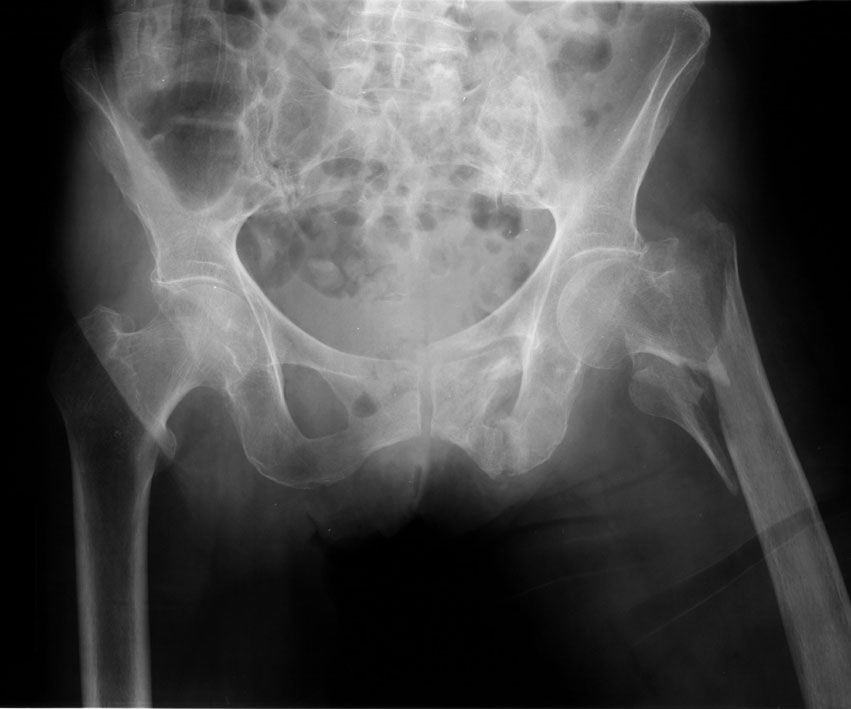
A 78 year old female patient is brought to the operating room with a fractured hip. She tells you that she wants to “go asleep” for the operation. How do you advise her?
Two papers in July’s Anesthesiology have shed light on this issue. Both studies mine large databases and so care must be taken to avoid over interpretation of data.
Neuman and colleagues (read here) looked at data at 126 New York hospitals over 2 years. Surprisingly, of 18,158 patients only 5,254 (29%) received regional (neuraxial) anesthesia. One in 40 patients died in hospital and, unadjusted, there was no difference in the rates of mortality between GA and RA. Patients receiving regional anesthesia experienced fewer pulmonary complications (359 [6.8%] vs. 1,040 [8.1%], P <0.005). Regional anesthesia was associated with a lower adjusted odds of mortality (odds ratio: 0.710, 95% CI 0.541, 0.932, P = 0.014) and pulmonary complications (odds ratio: 0.752, 95% CI 0.637, 0.887, P<0.001). The benefits associated with regional anesthesia accrued to patients only with intertrochanteric fractures; regional did not benefit patients with femoral neck fractures.

Memtsoudis and colleagues (read here) mined a 530,000 national (USA) database of patients undergoing primary hip and knee arthroplasty. One in 30 patients utilized critical care services. Patients that underwent general anaesthesia, elderly patients and those that has cardiopulmonary complications, were significantly more likely to use critical care. As one would expect, admission to the ICU was associated with significantly increased mortality (2.5% versus 0.1%). Patients were also more likely to enter ICU if they were in smaller non teaching hospitals and if they had hip rather than knee surgery.

Interestingly, this study utilized the Deyo index (here) rather than ASA physical status score. The Deyo index appears to be a strong predictor of outcomes in patients having major orthopedic surgery (here). Co-morbidlty indexes are very useful in clinical practice to predict risk (here). Indeed, the Deyo index and ASA-PS score have been used together to demonstrate adverse outcomes (here).

Giving up Colloid? – Yes we can!

Colloid lovers are distraught by the publication of the 6S study from Scandanavia, which has demonstrated that hydroxy ethyl starches (HES) were associated with poor outcomes (read here). For many of us, however, colloids are like nicotine, caffeine, carbohydrates and heroin rolled into one: we just believe in them. It’s so hard to stop. This month in Critical Care Medicine, a German hospital critical care group proved that you could – quit! (read here – subscription required)
In the Jena intensive care unit, over a 6 year period, clinicians initially used HES, gelatin and crystalloid, then gelatin and crystalloid and ultimately crystalloid only. Bayer and colleagues looked at CVP changes, SvO2, lactate normalisation, normalisation of MAP and discontinuation of vasopressors – comparing each phase against each other. In the first instance, CVP increased faster with colloids than crystalloids, which would be terrific if anyone had ever shown that rapidly increasing CVP improved outcomes. It doesn’t. In fact CVP is next to useless (if you don’t believe me – read this). Fluids are administered to reverse shock, and in each of the phases colloids had no appreciable benefit. Indeed, the amount colloid versus crystalloid was revealing: for HES it was 1:1.4 (HES vs Crystalloid i.e. 700ml Lactated Ringers versus 500ml HES 130/0.4); for gelatin it was 1:1.1 (i.e. 550ml LR versus 500ml gelatin). So there was little, if any, colloid effect. Moreover, patients in the crystalloid group mobilised fluid earlier than those in the colloid group.
So, colloids had no beneficial effect. What about harm? There was more acute kidney injury, worsened renal indices and longer continuous renal replacement therapy in the colloid group. Finally, patients who received colloids spent longer on mechanical ventilators than patients who received crystalloids.
It could be argued that this cohort study was flawed in that, as medicine advance, outcomes necessarily improve. So the newest patients should have had the best outcomes. However, there is no evidence that critical care outcomes are better now than 7 or 8 years ago, nor has the clinical practice move on significantly. From my perspective these data are valid, and may provide a roadmap to navigating ourselves away from the crutch and clutch of colloids.

EuSOS study published – and it’s not pretty!

46,539 patients from all over Europe were recruited to the The European Surgical Outcomes Study over 7 days in April 2011 (read here). Day cases, cardiac and neurosurgical patients were excluded. The overall mortality rate was 4% (nearly 1 in 20 patients). 8% of patients were admitted to ICU or HDU at some stage – but, astonishingly, 73% of those who died never saw a critical care practitioner.
For Ireland 856 patients were recruited into the study; 66 went to critical care beds postoperatively. Median hospital stay was 3 days (1.0-6.0). 6.4% died in hospital, with an unadjusted (for severity of illness) odds ratio of death (compared with the UK) of 1.86. When severity of illness was taken into account the OR of death was 2.61. This puts us down the scale of outcomes with Croatia, Slovakia (better), and Romania and Latvia (marginally worse).
What is truely frightening about these data – is that the reference country, the UK, aside from having a similar population to ours, had worse outcomes than they had expected (mortality 3.6% rather than the predicted 1.6%).
It could be argued that these data are skewed by relatively low numbers, recruitment exclusively in academic medical centers (private hospitals cherry pick the healthiest elective surgery patients), the significant limitations of the ASA physical status grade (between 2 and 3 there really should be 3 more grades – clinicians may have also reported patients as a ASA-PS 2 when they really were a 3), reporting bias etc. Alternatively, our patients might do badly because of  weaker nursing care at ward level and fewer critical care beds per head of population.
If the anaesthesia and critical care community in Ireland wants to look into this further, perhaps a worthwhile study would be an enthusiatic clinician to pull out the charts of all 856 patients and figure out why Ireland did so badly. Comments?