
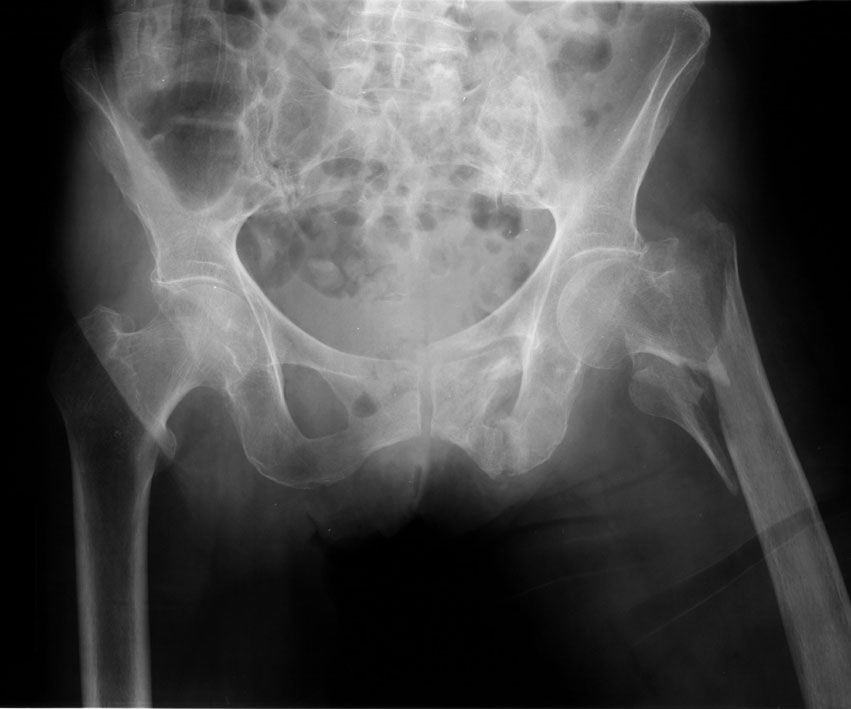
 A 78 year old female patient is brought to the operating room with a fractured hip. She tells you that she wants to “go asleep” for the operation. How do you advise her?
Two papers in July’s Anesthesiology have shed light on this issue. Both studies mine large databases and so care must be taken to avoid over interpretation of data.
Neuman and colleagues (read here) looked at data at 126 New York hospitals over 2 years. Surprisingly, of 18,158 patients only 5,254 (29%) received regional (neuraxial) anesthesia. One in 40 patients died in hospital and, unadjusted, there was no difference in the rates of mortality between GA and RA. Patients receiving regional anesthesia experienced fewer pulmonary complications (359 [6.8%] vs. 1,040 [8.1%], P <0.005). Regional anesthesia was associated with a lower adjusted odds of mortality (odds ratio: 0.710, 95% CI 0.541, 0.932, P = 0.014) and pulmonary complications (odds ratio: 0.752, 95% CI 0.637, 0.887, P<0.001). The benefits associated with regional anesthesia accrued to patients only with intertrochanteric fractures; regional did not benefit patients with femoral neck fractures.
Memtsoudis and colleagues (read here) mined a 530,000 national (USA) database of patients undergoing primary hip and knee arthroplasty. One in 30 patients utilized critical care services. Patients that underwent general anaesthesia, elderly patients and those that has cardiopulmonary complications, were significantly more likely to use critical care. As one would expect, admission to the ICU was associated with significantly increased mortality (2.5% versus 0.1%). Patients were also more likely to enter ICU if they were in smaller non teaching hospitals and if they had hip rather than knee surgery.
Interestingly, this study utilized the Deyo index (here) rather than ASA physical status score. The Deyo index appears to be a strong predictor of outcomes in patients having major orthopedic surgery (here). Co-morbidlty indexes are very useful in clinical practice to predict risk (here). Indeed, the Deyo index and ASA-PS score have been used together to demonstrate adverse outcomes (here).
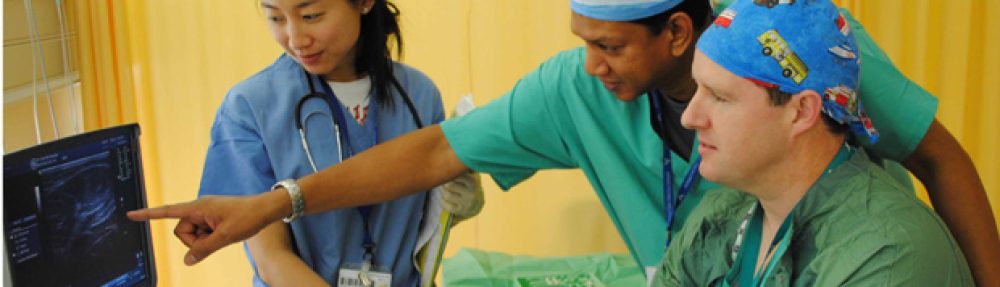
 Most of the time that we palpate the spine (70%) we are incorrect at assessing the level of the spine that we are palpating blindly. In the future ultrasound guidance will be standard of care for spinal anesthesia, according to Jose Carvlho, from Toronto at the Western Anaesthesia Symposium.
 When you do the transverse scan – you see the sharp (paper cut) dural space – and you can measure, clearly, from the skin, the depth of the dura. Then you mark at the level that you had a great view of the space (vertically). You have now 2 marks on the skin – draw intersecting lines – and voila the point that you find is the needle insertion site!
 AnaesthesiaWest